
Automatic air freshener, the timed spray on the wall explained
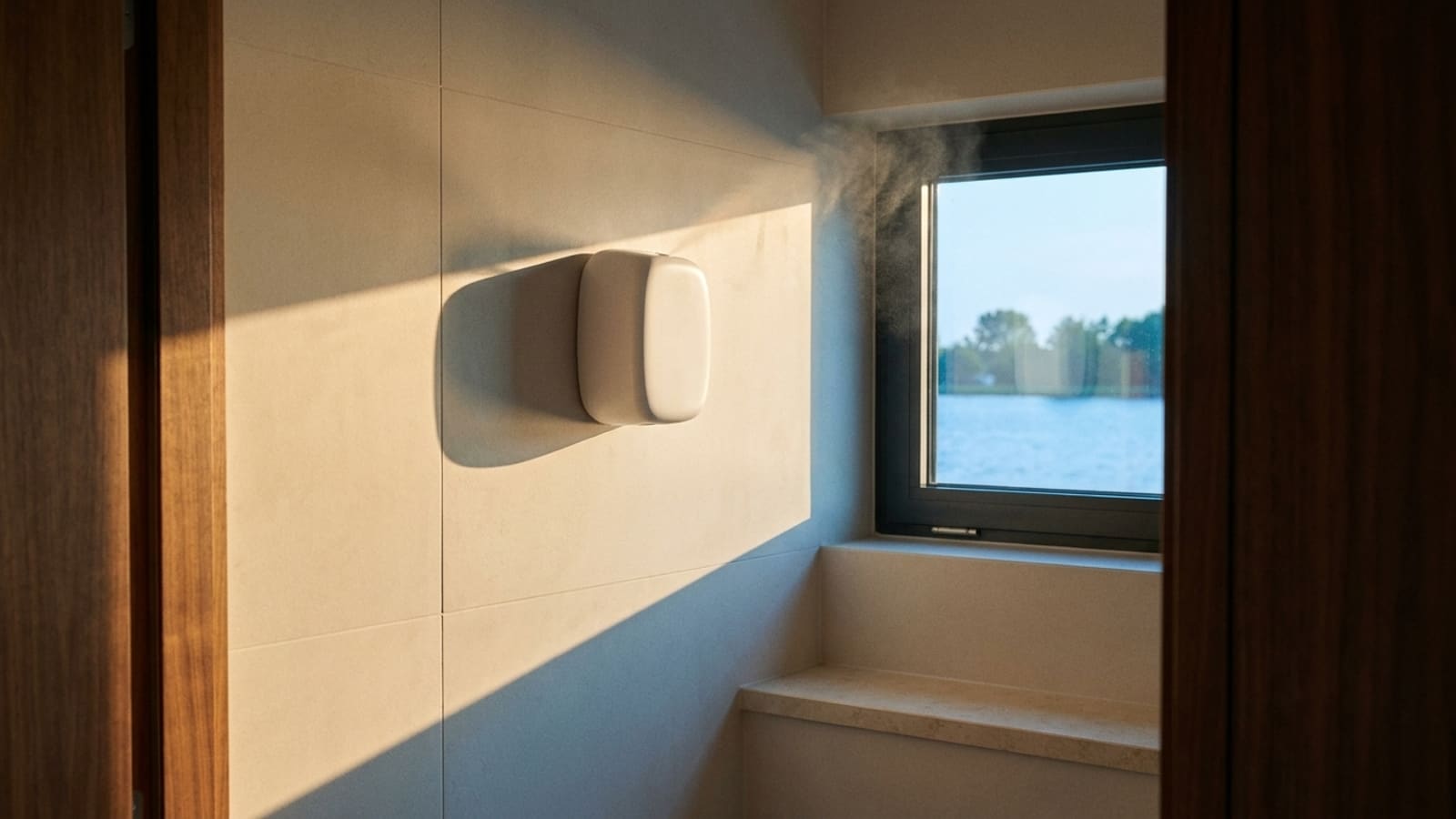
An automatic air freshener is a battery-powered box on the wall of a loo, hallway or kitchen that holds an aerosol can and sprays a short burst of scent on a timer or when its sensor picks up movement. The interval you choose decides how long the can lasts.
By the editors of Aromatherapy Diffuser GuideUpdated 16 October 20265 min read
In short
- A small motor presses the aerosol can at a set interval or when the sensor spots someone; the click is that press.
- A longer gap, a sensor and a night mode make a can last longer; the weeks on the pack assume the longest gap.
- Mount it high with nothing in the line of spray, never above a hob or near a cat's tray.
What the box on the wall actually does
Open the front cover and there are three things inside: a slot for an aerosol can, a motor with an arm that presses the nozzle, and a battery compartment. At the chosen interval the motor presses the can for a fraction of a second and a fine cloud leaves through the lid. That press is the click you hear.
Some units add a light sensor, so they stay quiet in the dark, or a motion sensor that sprays only after someone has walked past.
Interval, sensor and what a can lasts
The main control is the interval switch: a short, medium or long gap between sprays. The can holds a fixed number of bursts, so the gap decides how many weeks it lasts. The weeks on the pack are counted on the longest gap, often with a night pause, so a short gap empties the same can far sooner.
- Longest gap: the can lasts longest and the scent is faint between sprays. Start here.
- Motion sensor: the unit waits for someone, so an empty hallway uses nothing.
- Light sensor or night mode: no sprays once the light is off, which spares the can and a light sleeper along the landing.
Height, the line of spray and the walls to avoid
Height is the whole point. The spray falls as it spreads and nobody should walk into it, so the unit goes above head height, pointing into the open room rather than at the door.
- Not at head height, and never where a child could look up into the opening.
- Not above or beside a hob, a toaster or any open flame; the propellant is flammable.
- Not above a worktop, a toothbrush mug or a towel rail; the spray lands on whatever is under it.
- Not near a cat's litter tray or a pet's bowl; an animal cannot walk away from a scent it dislikes.
The loo, the cloakroom and the hallway are where these units earn their place, with a kitchen only if the wall is away from the cooking. For a living room, where a burst every so often is the wrong shape of scent, our comparison of electric diffusers that hold a steady level in a living room is the better read.
Propellant, ventilation and the click
An aerosol can carries its scent on a propellant, a gas under pressure that is flammable until it has dispersed, which is why the can warns against heat and flame and the unit should not hang near a hob or above a radiator. In a windowless loo, the extractor fan or an open door stands in for a window.
The click is mechanical and cannot be turned off, only timed; on a landing outside a bedroom it carries at night, so a night mode matters there. Flat batteries usually show as missed sprays before the can is empty.
What it costs to run, worked out your way
There is no figure to quote; the sum changes with every setting. Take the price of a refill can, note the date you fit it, and divide the price by the weeks it lasts on the gap you use. Add batteries when they go flat. Do the same for a plug-in refill, a reed bottle or a diffuser pod and the comparison is fair; the refill-per-month figures in our electric diffuser guide show the hours a day each assumes.
Which rooms want a burst, and which want a steady level
| Room | Burst or steady | What suits it |
|---|---|---|
| Loo or cloakroom | A burst | Automatic spray on the longest gap |
| Hallway or landing | A burst, with a night mode | Automatic spray or a plug-in |
| Kitchen | A burst, well away from the hob | A spray on the far wall |
| Living room | Steady | Electric oil diffuser on a schedule, or reeds |
| Bedroom | Faint or nothing | Reeds, or a diffuser that switches itself off |
The automatic spray suits a room people pass through: it covers a smell quickly and asks nothing of you until the can runs out. In a room you sit in, a burst and then a fade is not what most people want.
A plug-in holds a steady level in a modest room; reeds give a faint one with no sound. An electric oil diffuser with a schedule starts and stops at set times and holds a level in between. We set those machines side by side on the page that weighs coverage, noise and refill cost for a room you sit in.
Want a steady scent rather than a burst?
Our guide compares electric oil diffusers for British homes on coverage, noise, refill cost and app control.